
A Few Words on Dominique Malonga

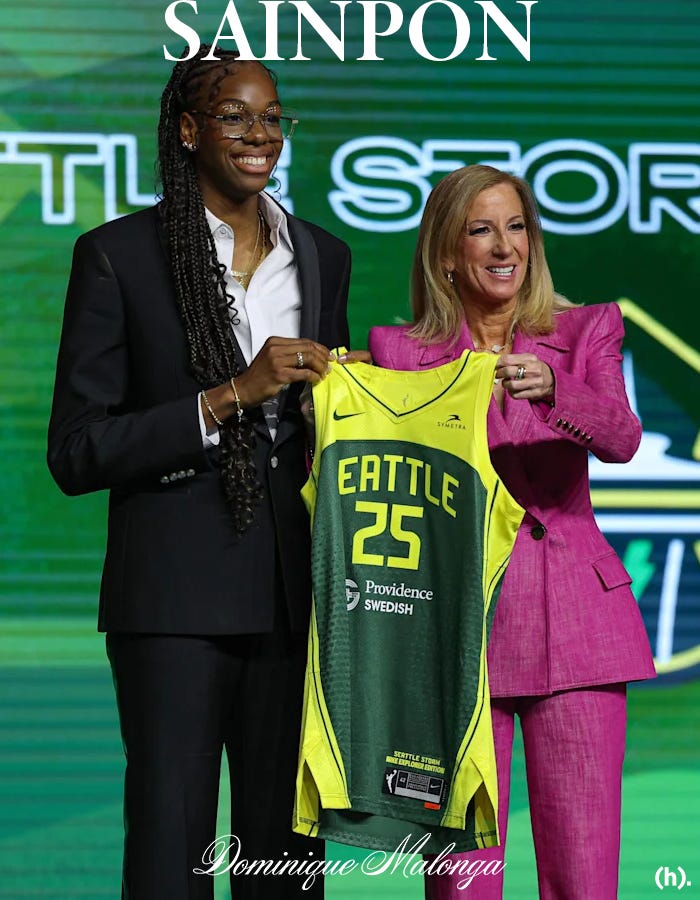
The prominence of Dominique Malonga looms in the backdrop of a young, intense, convoluted, sociological, racial, and quintessentially American storyline between superstars Angel Reese, Caitlin Clark, and Paige Bueckers. A storyline stretching far beyond the bounds of the basketball court, one far beyond any action enacted by Reese, Clark, or Bueckers; a storyline transfigured by audiences—fans and media alike—into a political hellfire akin to the expansive and exponentially rising hellfire engulfing the United States of America today. The lore between the three—Reese, Clark, Bueckers—-captivates its competitive and theatrical nature. Each interaction births new commentary beyond the spectrum of basketball, acting as a premise into deliberating the cultural prejudices and sociopolitical dynamics that subsist in the American lifestyle. It is an inescapable storyline; its three dominant forces leaving little left over to discuss the basketball of it all. Rather, its magnanimity dwarfs whatever else is around. Dominique Malonga, for instance.
Dominique Malonga presented an echelon of talent, intellect, and pliability through 40 WNBA games that is only manifested by players whose future is destined for superstardom. Not merely the sporadic all-star appearance, fringe all-WNBA selection, respected franchise talent who through a week of great basketball earns WNBA player of the week—a superstar who commands fear and respect from opposing coaches to players to fans.
Upon draft night, prior to any WNBA games, Malonga stood an outlier amongst colleagues. As an international prospect competing in Euro Cup representing ASVEL Feminin, Malonga already was a professional athlete entering the WNBA, becoming only the third non-collegiate prospect in the past two decades to be selected in the top five of a draft class. And as a non-collegiate prospect, Malonga, eligible, declared for the WNBA draft at 19 years of age, whereas NCAA athletes are ineligible to declare until 21, approaching 22 years old.
Following a three-team deal between the Las Vegas Aces, the Los Angeles Sparks, the original owners of the second overall pick, and the Seattle Storm—Seattle jumped at the opportunity to relinquish star veteran guard Jewell Loyd in exchange for the promising future of Frenchwoman Dominique Malonga. Though, the absence of 30-year-old Jewell Loyd and insertion of 19-year-old Dominique Malonga did not reshape the structure nor overall goal of the Seattle Storm organization for the season. Where the Dallas Wings and Washington Mystics, owners of the first and third overall pick respectively, two of the four bottom teams in the league, the Wings winning a mere 9 games and Mystics 14 out of the 40 game regular season, the Storm were a playoff team—5th in the standings with a 25-15 record. In the departure of Loyd, Seattle’s roster still featured Gabby Williams, Skylar Diggins, and Nneka Ogwumike, the three players all thereafter earning All-Star selections; Williams additionally earning a first-team all-defense selection.
The obligation, the responsibility to compete for a title is the consequence of a roster featuring three all-stars—and enabling a young, unfinished rookie the freedom to make mistakes but nonetheless play extended minutes in the hopes of expedited development is wholly incongruent, daresay antithesis to title ambitions. Thus Malonga, second overall pick, the French phenom, was relegated to Seattle’s bench, scraping for minutes. Entering the all-star break, 20 of 40 regular season games completed, Malonga averaged a hair under 9 minutes of playing time, at 8.8 minutes per game. Paige Bueckers, first overall pick of Malonga’s class, Sonia Citron, third overall pick, averaged 34.9 and 33.5 minutes per game respectively. Few possessions there were to observe Malonga as a player, and a few minutes there were to evaluate her as a teammate.
Limited minutes however, Malonga in an instant was exposed to physicality at a degree impossible to prepare for, its severity grasped only by experience, the rush of colliding bodies akin to the heat rushing to one’s face as it escapes out from the oven door. The heat—Alyssa Thomas, Aliyah Boston, A’ja Wilson, Angel Reese, Napheesa Collier, Brionna Jones, etc.—was overwhelming for 19-year-old Dominique Malonga. A slender 6’6, somewhat analogous to her Frenchman counterpart Victor Wembanyama—Wemby’s anthropometrics are somehow even further otherworldly—was overwhelmed, promptly shut off from her routine scoring, rebounding, by the bumping, shoving, handsy WNBA defender. Take for instance possessions in which Malonga drives to the basket. Whereas in possessions a roller, in which Malonga scores at league efficiency as a beneficiary of her pick-and-roll partner Erica Wheeler, a 37% 3pt shooter, or All-Star Skylar Diggins, in which teams option to employ defensive coverages that assign two on the aforementioned guards at the perimeter, abandoning Malonga racing downhill, wide open, her responsibility narrowed to catching the ball, looking up to the rim, not traveling, and laying the ball in—-Malonga is burdened with putting the ball on the floor and creating the basket all in her lonesome as a driver. There her strength is challenged. Her footwork, patience, shot making, all challenged as every detail matters when it is her, one-on-one, attacking the defender.
Malonga from the outset showed the ability to gain inside leverage against defenders in soft man/drop with her raw speed. Off the catch, from the three-point line, Malonga consistently beat defenders that gave her space to drive; those set in coverage below the 3pt-line, sometimes well below. However, while speed at her advantage, her defender pinned to the side of her body, the path to the rim seemingly open. There remained the defender’s ability to deter with sheer contact. Malonga, as a teenager, is particularly vulnerable to contact defending. There subsists a difficulty in finishing around the rim whilst an opposing force encroaches upon one’s shot. This dynamic drives to her benefit generated the highest free-throw rate among play types; the detractor being Malonga’s drives also generated her highest turnover rate.
It is within expectations that the youngest player in the league accompanied with a slight, elongated frame instinctively avoids the bumps and bruises, quickly amasses turnovers, and battles for efficiency in their self-created offensive possessions. The key is Malonga has natural advantage creation through her athleticism. At 19-years-old, Malonga already has consistently established initial advantages against players a decade superior—the technical aspects, in contrast to advantage creation, are far simpler to improve upon, both in time and comprehension. Physical training builds resilience to contact. Skill training refines one’s footwork and decision making. The natural advantage creation—Malonga’s speed, her hands, her mobility, dexterity, and fluidity at 6 ‘6, is practically impossible to train into one without it. Angel Reese for instance: Beyond her rebounding and post-ups at LSU, there was further potential in Reese as a slasher, given her physically imposing and relatively fluid downhill capabilities as a 6 ‘3 forward. Reese however converted a mere 22.0% of her 2pt drives her rookie season, solidifying herself as one of the worst downhill creators in the WNBA that year. Through training, which Reese shared snippets of through multiple social media platforms regularly throughout the offseason, Reese’s driving efficiency vaulted nearly twicefold from rookie to sophomore year—22.0% to 46.6%. Her natural advantage creation laid the foundation for technical development that is scaling into a refined, put together, concise structure that defenses must now account for in their coverages, a reflection of Reese furthering her offensive impact on the floor. Malonga in her journey will utilize the off-seasons in the same fashion, improving and refining the technicals, and accordingly scaling her offense.
Post All-Star break, in the remaining 20 regular season games, Malonga averaged 20.3 minutes, 11.4 points, 6.7 rebounds, 1.1 assists, shooting 57.6% from the field and 36.4% 3pt. The progression from end of the bench rotation garbage-time asset to competing, sixth-player of the year candidate eventuated not by the transmutation of her weaknesses, dissolved to nothingness if not reborn into strengths—rather the enrichment of techniques that interlace; the composition of the fabric that is Malonga’s play-finishing forte. The WNBA environment can be described as rough-weather conditions—one that challenges comfort, the solidity and resilience of the very interlacing fibers that make up the fabric of a player. These are conditions that necessitate material produced specialized against tumultuous conditions, durable and adaptive to the unprecedented, austere nature of it all—akin to the mountaineer who supplants cotton for a pair of merino wool socks in preparation for his exhaustive, strenuous expedition.
Malonga’s forte has consistently involved possessions in which she can stretch out and score in transition, or act as the final connection from ball to rim whether it be in the form of offensive rebounds, as the roller, or cutter. These possessions in particular optimize her exceptional composition of bounding height, expansive length, tremendous athleticism, whilst being devoid of requisite, sophisticated technical abilities that self-creation calls upon, enabling Malonga to focus solely on positioning and execution.
In modest conditions, as one describes the approach in contrast to the mountain climb, Malonga’s techniques were suitable for the international competition with Lyon Asvel. Her footwork, screening, finishing, all acceptable—in fact, excellent. As transitioned from approach and began her climb, ascent—declaring and then signing to the WNBA, the professional home of every United States women’s gold medalist, who have proven with unambiguity their global sovereignty over the sport of basketball—the air began to thin, the labor of the journey was felt on the body, the quality of technique that was suitable in approach faltered in the climb. Malonga required further precision, confidence, and intuitiveness to conquer the mountain climb. And that she did.
As defenses acknowledged Malonga’s dominance against ball-handler oriented pick-and-roll coverages, in which backline help is left to take up sole responsibility for containing the rolling 6’6 center, coverages shifted towards variations of a soft hedge: the point-of-attack (POA) matched against one of Skylar Diggins, Brittany Sykes, or Erica Wheeler, and the screen-defender containing the open lane created by Malonga’s pick, and the ever shifting passing windows the ball-handler has at their disposable to the rolling Malonga, dashing past the back of the screen-defender. In tandem with hedging, defenses continued to send weakside or nail help, executing a poor man’s double—collapsing on Malonga if she were ever to receive the ball. Denying Malonga the ball was impractical; her standing reach at 6 ‘6 far exceeds that of her defenders, even if one were to jump. Doubling was the next best option. In adapting to this steep ascent, thinner air, her comfort playing freely in straight drive lanes to the basket then concluded—Malonga gradually refined her timing and positioning off-ball to acclimatize. Beginning with the angle of approach, Malonga reached consistency setting screens in a manner that best complimented the tendencies of her PnR partner, optimizing the outcome of ball-screen actions from genesis. Malonga’s synergistic efforts flowed through the possession, aptly setting screens then releasing downhill at a pace in accordance with the tempo of her guard, further optimizing scoring and passing windows whilst simultaneously limiting turnover rate. By season’s end, Malonga ranked T10 among all rollers (averaging a minimum one possession per game) in effective field-goal percentage.
The dexterous and mobile aspects of Malonga’s grand athleticism unlocked a greater avenue of scoring amidst the rugged rookie ascent: Her unsuspecting speed, extended strides, great hands, and fluid body coordination enabled excellent and efficient scoring in transition. At 6’6, often the tallest on the court, also became the fastest on the court, on the open floor. Consistently speed cast Malonga behind the defense, or rather, ahead of the defense, in which a defense’s backline foremost concerned with containing the ball-handler penetrating halfcourt loses Malonga leaking out ahead to the cup. Adept defenses, teams with the capability to manage both the racing Malonga and the intruding ball-handler, at best deny the outlet passes, containing the passing windows to Malonga. This scheme however tends to invite ball-handlers deep into the paint, with personnel overextended in denying the pass, forsaking the player with the ball—relinquishing the ball-handler free reign to the basket. The deep paint touch in desperation drives help to finally rotate on-ball, “help” customarily being Malonga’s defender, in which Malonga is once again left open, an easy dump off to her for the basket. Independently, Malonga has shown the capacity for self-sufficiency, snatching a defensive rebound and unassisted takes the ball coast-to-coast, blazing through and past defenders for a bucket.
Amongst all features of Malonga, the most impactful, transient-bound stands her defense. Channeling her profound talents Malonga quickly consummated a tasteful, esthetical scoring craft chalked with variations of post-spin fadeaway jumpers, the kind of eye-catching shot-creation that ignites great anticipation in the observer for the times of Malonga’s domination over the WNBA, the kind that solicits similitudes to the all-time great scorers. Transcending these longings howbeit lies Malonga’s promise as a defender. It again begins with her height and athleticism, the amalgamation of two intrinsic values measured historically top percentile, finished with an intellect and intuition for the goings and happenings of basketball; it is a composition of values rendering the impression of inevitable eminence.
It bears great significance the youngest player in the league, Dominique Malonga, through her first season sustained the defensive efficacy of a Seattle Storm team 4th in dRTG, coming off the bench in substitution for two premiere, all-defensive frontcourt players in Ezi Magbegor and Nneka Ogwumike. Absent are grand counting stats to cite, readily verifying the defensive prestige of Malonga, averaging a mere 0.7 blocks and 0.4 steals a game. Present nonetheless, is the lineup data indicating nominal drop off in dRTG with Malonga on the floor and All-Defensive Forward Ezi Magbegor off, and filtering out low-leverage possessions, the dRTG of rookie Malonga on and defensive savant Ezi Magbegor or Nneka Ogwumike off stands unchanged.
To defend at center, the position of de facto anchor in defensive schemes, calls for broad defensive competency. Ball-screen coverages, post defense, weakside rim protection, switches, perimeter defense, isolation defense, help-defense—it is a wide, diverse set of actions the center inherits significant responsibility for containing, deterring, and blocking. Beyond the theoretical, conceptual complexity a big is called upon to guard; it is a big called to defend one-on-one against A’ja Wilson or Napheesa Collier, the two best players in the world by significant margin. Malonga, in her first WNBA postseason series, was called to guard reigning MVP, eventual back-to-back MVP, back-to-back scoring champion, 2025 WNBA champion, and 2025 Finals MVP, A’ja Wilson.
It is a win or go home game two for the Seattle Storm, the Las Vegas Aces with a 1-0 advantage in the best-of-three series. Fourth quarter, Aces up eight, A’ja Wilson checks in the game with 8:24 to go, 71-63. Malonga correspondingly is swapped out for the Storm’s leading scorer, Nneka Ogwumike, the respective teams’ star players returning to the action. Without delay, A’ja Wilson gets to work, drawing a foul against Ezi Magbegor with a middle lane left-hand (Wilson’s dominant hand) right-spin step-through drive to the rim. The following Aces possession, Wilson continues working the Storm, this time drawing a foul against Nneka Ogwumike out the left lane low post with a back-to-the-basket, right dribble, spin fade jumper going right, Ogwumike catching Wilson’s elbow with her contest. The Wilson tirade continues against the Malonga-less frontcourt: She draws her third consecutive foul in the Aces third consecutive possession since checking in, Ezi Magbegor once again her victim, as Wilson top of the key out denies Jackie Young’s left-wing ball screen, racing middle lane to the basket, but intuitively feeling the hand of the beat Magbegor at her waist, pulls-up for a ten-foot midrange jumper, drawing the foul and-one. The Storm earn a rest from the Wilson takeover thanks to a Jackie Young turnover (traveling violation), though the very following possession Wilson returned swiftly to pummeling their frontcourt stars, drawing yet another foul against Ezi Magbebor, the third against Magbebor in roughly two minutes of playing time. In deep foul trouble, Head Coach Noelle Quinn is obliged to pull Magbebor, sending Malonga into the full depths of the playoffs. A determined, aggressive A’ja Wilson,an elimination game, down 10, with 6:04 remaining (75-65).
As Wilson made her presence known instantly upon checking in, Malonga followed suit, blocking Jackie Young at the rim and securing the rebound, holding the deficit to ten points. The next Aces possession Jackie Young continued looking to feed A’ja Wilson, though Wilson was uninterested in forcing the issue one-on-one against Malonga, no longer matched up with Magbegor, deferring to Chelsea Gray. Young scratched and clawed for Vegas’ next four points, keeping Seattle out of striking distance as the two teams descended into clutch time, with 4:50 to go (79-70).
Empty side low block, Wilson flash cuts middle of the paint, promptly shooting her famed pull-up middy upon receipt. Yet, the action wasn’t quick enough to beat Malonga, who snuffed out Wilson’s jumper, registering her second block in less than two minutes of playing time. On the other end, after a slew of non-shooting fouls called against the Aces, Skylar Diggins hits a three over a skying Wilson to cut the lead to 6. Aces once again look to feed Wilson against Malonga, using Jewell Lloyd this possession to set a cross screen for Wilson at the weakside nail, Chelsea Gray sending a bounce entry pass to the cutting Wilson at the strong-side low block. Malonga held her ground through the action, recovering from the cross-screen, closing out space against Wilson to contain her driving lanes to the rim, and stayed to the ground through Wilson’s post-spin shot fakes, avoiding the foul, and forcing Wilson to cough up the ball back to Chelsea Gray. Erica Wheeler cashes in a corner three, assisted by Malonga, the lead cut down to three with 3:03 remaining (79-76). A’ja Wilson went scoreless in the 3 minutes after Malonga checked into the game. The two teams tussled for the ensuing two minutes, a back and forth that kept the Aces ahead with a four-point lead. Malonga had effectively iced Wilson out the game; Wilson continually deferring the ball against the 6 ‘6 rookie in positions she otherwise looked to score in when matched with Ezi Magbebor.
Less than 45 seconds to the final buzzer, 83-81 Aces; A’ja Wilson tried her hand once more against Malonga, a left-lane face-up middy, clanking the front rim. Nneka Ogwumike grabs the defensive rebound, passes it up to Skylar Diggins, and Diggins, immediately spotting Dominique Malonga leaking out in transition ahead of all five Vegas players, launches an outlet pass to the outstretched hands of Malonga, who catches the ball in stride and finishes through a Chelsea Gray foul and-one. With her free-throw, Malonga put the Storm ahead by a single point, 83-84, after trailing through two quarters. 27 seconds to buzzer, Chelsea Gray makes a poor inbounding pass, turning the ball over back to the Seattle Storm. Diggins, iso, whittles the shot clock down to one second, four seconds game clock, before icing out the Aces with a pull-up middy over a hounding Jackie Young. Jewell Lloyd with four seconds chucks a three 27-feet out, misses, and the Seattle Storm win game 2, avoiding elimination, their rookie off the bench holding the best player in the league scoreless single-handedly in the final six minutes of the game.