
A Few Words on Kon Knueppel, Barttorvik, & NBA Comps - A Review
An Analysis

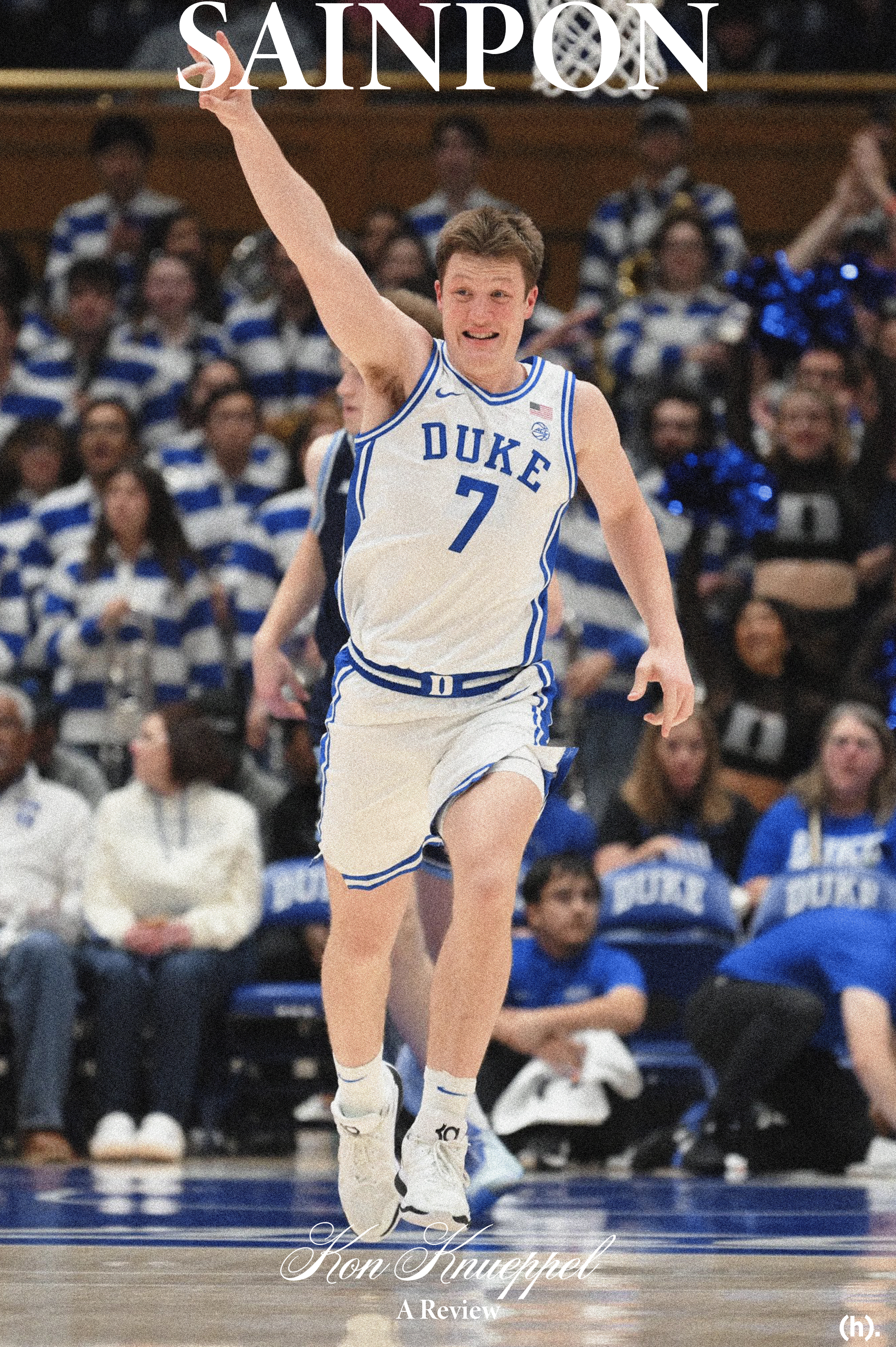
It is neither first overall pick 19-year-old NCAA NPOY Cooper Flagg, or second overall pick and protege nepo point guard Dylan Harper, son of 5-time NBA champion Ron Harper, as of current leading the NBA’s rookie of the year race. Rather it is the 6’7 Milwaukee-born, fourth overall pick, Kon Knueppel. The overarching success of Knueppel was to be expected as a top-five draft pick, specifically as a top-five draftee exiting a hyper-efficient one-and-done season at Duke alongside tantamount prospects Cooper Flagg and Khaman Maluach as a vital contributor to the programs 23rd ACC Tournament Championship (earning tournament MVP) and 18th Final Four appearance. The early success to the magnitude Knueppel has achieved this season however—the fastest player in NBA history to reach 100 career three-pointers—was entirely unanticipated.
In times of prognostic-defiance, a time of which Kon Knueppel is averaging 20.6/5.6/3.8 per75 on +5.4 rTS% through the first 29 professional games of his career, a time in which with every succeeding month Knueppel inscribes himself atop another page within the history books, births an opportune time to retrace and investigate the proceedings building up to the current present, in mission to realign prognostication of “very good shooter” with the actuality of “all-time shooter”. It is parsing through qualitative, quantitative archives and extracting details that can be overseen when simultaneously evaluating a myriad of other prospects.
The initial difficulty of evaluating Kon Knueppel at Duke, prior any extensive analysis, lies in the magnificence of his teammates, or rather, a teammate: Cooper Flagg. 17-years-old, Flagg entered the NCAA as High School Gatorade National Player of the Year, Mr. Basketball, Naismith Prep Player of the Year, and National High School Invitational Champion. He was, by all means, the best high school prospect of the class, all the while being the youngest. Fast forward to the close of their freshman season, and an 18-year-old Cooper Flagg led 35-4 Duke in all major statistical categories: points, rebounds, assists, blocks, steals. The litany of conference and national awards and accolades affirmed his dominance, the fourth player in conference history to win ACC Player of the Year and ACC Rookie of the Year, the fourth freshman in NCAA history to win National Player of the Year. The contributions of Flagg were inseparable in matters concerning Knueppel, or any player on the roster. It could very well be assumed Knueppel’s success was a byproduct of one as the beneficiary of Flagg, rather than the consequence of self-cultivated ability and skill.
Knueppel’s light eventually reached the vision of the NBA front offices, drafted fourth overall, breaking through Flagg’s obfuscating presence, indefatigability fueled by potent perimeter offensive firepower.
Bart Torvik (barttorvik.com) is the most accessible interactive collegiate statistical database (by far as of current with the addition of Women’s NCAAB ) to contextualize the exact scale of Knueppel’s aforementioned firepower in quantitative, historical precedent. Bart Torvik (Bart) is an indispensable instrument for grassroots scouts, those of who began their scouting career publishing content on Twitter or YouTube, independently, a handful of those creators eventually handpicked by NBA teams to join their scouting departments. Adam Spinella for instance, also known as Coach Spins, host of YouTube channel “The Box and One”, accepted a scouting role with the Philadephia 76ers back in October 2023 (the 76ers subsequently drafting Jared McCain 16th overall in the following draft; McCain took the NBA world by storm averaging 23.8 ppg in 8 games starting and 15.3 ppg in 23 games overall before enduring a season-ending leg injury). Prior to joining the 76ers, Spinella would frequently share Bart query results with his thousands of Twitter followers, identifying statistical parallels between NBA prospects of now and the prospects of the past.
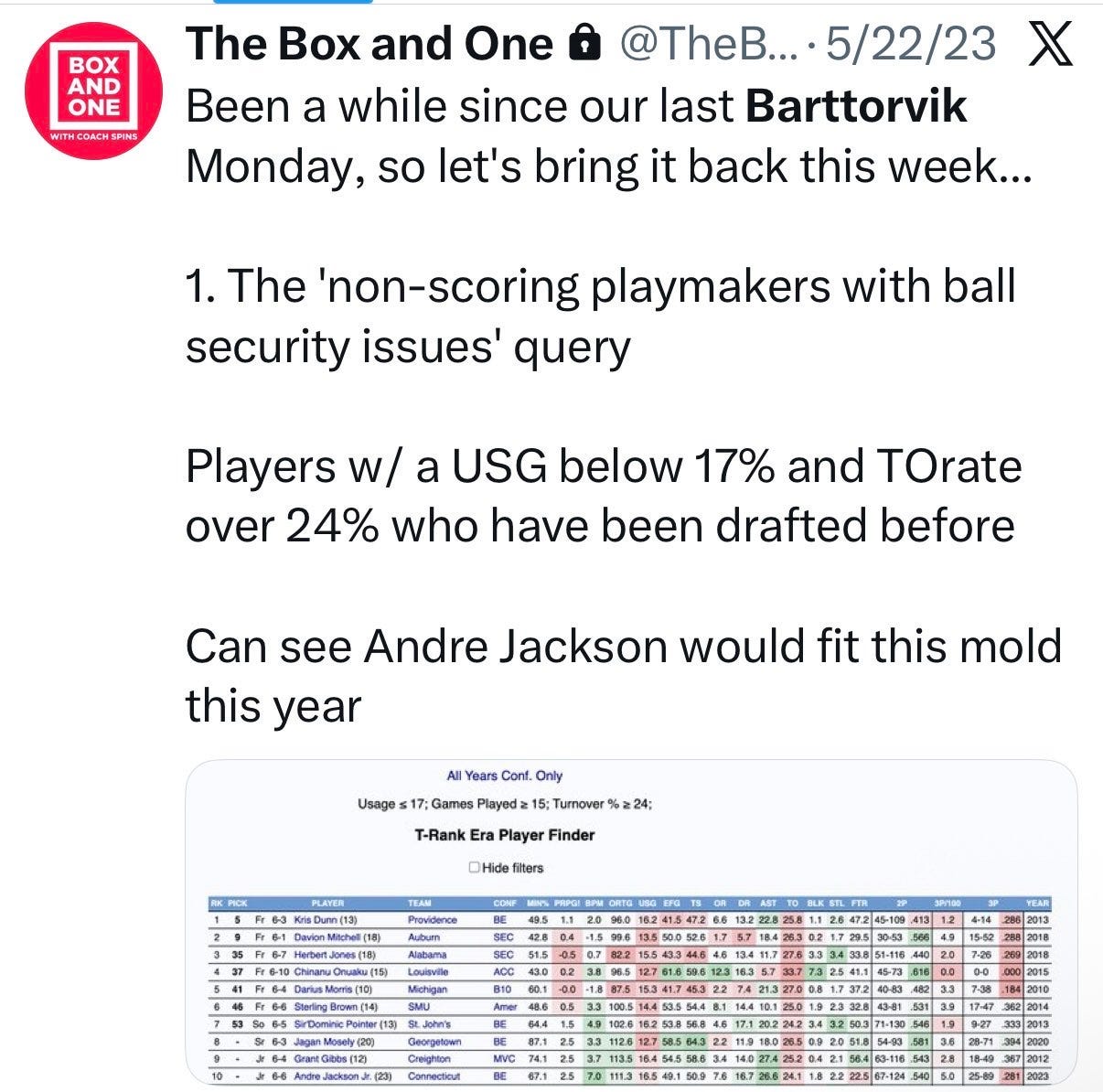
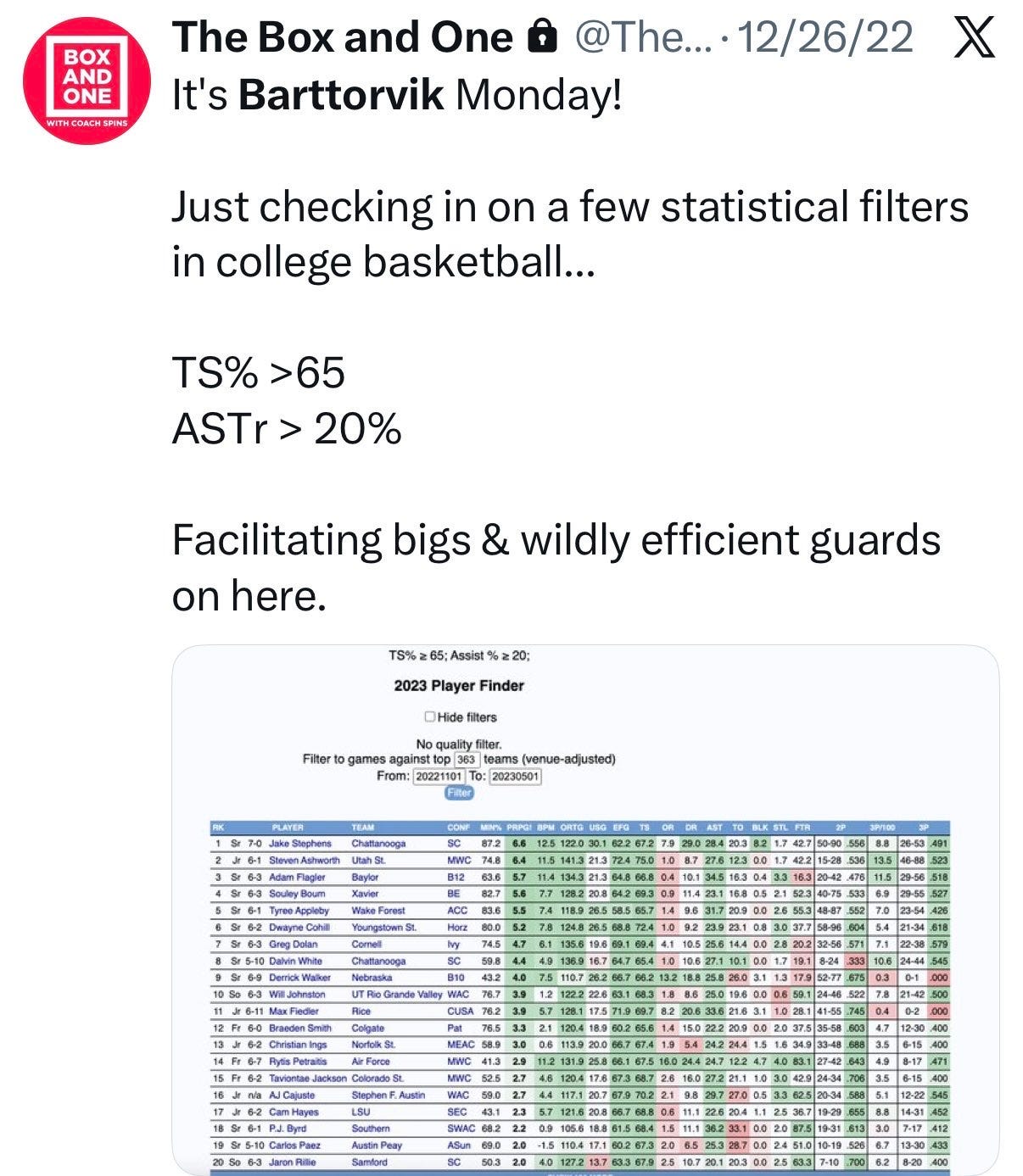
To summarize, Bart’s player query feature allows users to discover historical, statistical precedence through a combination of stat value filters (the data base spans back to 2008). If one wants to know all freshmen since 2008 to attempt a minimum 200 threes in a season for instance, Bart can generate the list of players.
Formulating a query with a set of basic statistical parameters—draft status, height, class, role, three-point rate, two-point attempts—relative to the prospect at hand, in this case Kon Knueppel, will generate an index of players who loosely overlap in skillset, strengths and weaknesses, clarifying the bounds of the prospect.
Draft Status: FRP
Height: ≥6’5
3pa/100: ≥10
Class: Freshman
Role: Wing Guard
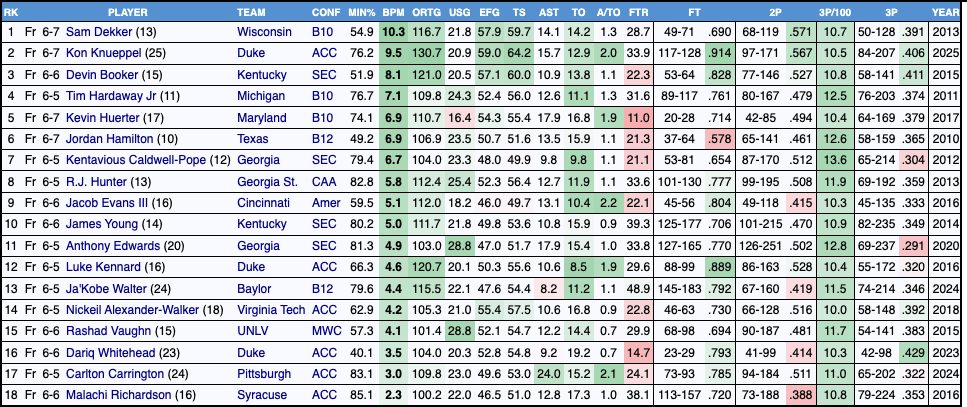
Knueppel’s initial query is identifying all tall, high-volume three-point shooting “Wing Guard” freshman prospects. This initial query does not discriminate based upon efficiency or impact (box plus-minus). This allows for a wide range of outcomes, a few names that are commonly cited in eye-test comparisons, others who share the general archetype, and a few who vastly differ in playstyle.
With the initial query serving as the bounds of Knueppel, analysis transitions to identifying what concerning Knueppel delineates him from the others, beneficial or detrimental. It calls for a return to the qualitative observations made watching his film.
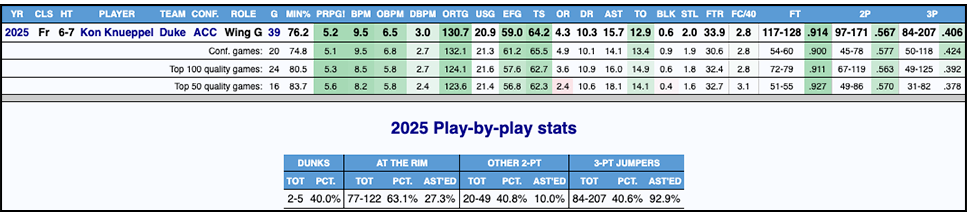
Knueppel’s perimeter shooting talent is statistically self-evident, 207 three-point attempts, 40.6% 3pt—he’s the sole prospect of the query with ≥200 3pa shooting ≥40% 3pt, though not the sole elite shooting prospect of the query. Devin Booker, Tim Hardaway Jr., and Kevin Huerter also billing impressive shooting seasons. Exclusive to the film is Knueppel exuding great comfort countering aggressive closeout defenses. A conclusion drawn by the fluency and depth of Knueppel’s abilities in off-ball relocation, at the rim, and the precise execution of his in-between game, a degree of expertise by Knueppel grading closer to that of a primary ball-handler or point guard than a three-point off-ball wing, especially through his playmaking and overall pace of play. The core weakness of a three-point specialist like Kispert, Kennard, Hardaway, or Huerter is their vulnerability and variability on-ball. Generally the three-point specialist can adequately counter simple closeouts and execute a high pick-and-roll versus plain PnR coverages such as drop. When the halfcourt possession escalates in complexity however, possessions in which their first read off-the-catch—a pull-up three for instance—is not the best shot available, their offense collapses. Tim Hardaway Jr. can for all intents and purposes dribble the basketball. He can shoot a pull-up three, a pull-up middy, even get to the rim when facing closeout pressure at the perimeter. Tim Hardaway Jr. cannot however, proficiently manage primary-esque ball pressure. Meaning, Hardaway struggles mightily driving against the culmination of POA, strong-side digs, and the low-man rotating to contest at-the-rim. Hardaway, Kispert, Kennard, or Huerter, unlike Kon Knueppel, are overwhelmed in the presence of multilayered, impromptu, constricting defensive schemes, instinctively rushing into bad, off balance, out of rhythm shot attempts, sped up by the looming threat of turnover. One could further this observation of capability into the domain of psychology, through the well known psychological reaction “fight-or-flight”. Knueppel in the presence of these complex threats expresses an eagerness to fight, whilst his NBA comparisons elect flight, conceding to their opponents. This dichotomy expanded over an culmination of games explains Knueppel his rookie season shooting 40% 3pt and 57% 3pt whilst averaging 20ppg (per75), whilst 2017-18 Hardaway Jr. (year five), averaging 19.5ppg (per75) with the Knicks, shot a much worse 31.7% 3pt and 44.2% 2pt on -2.6% rTS. Knueppel instinctive to fight ousts the poor shot quality Tim Hardaway Jr. cubbyholes himself into. It is also Knueppel taking 15.2 fga (per75) a game, while Kennard or Kispert have been fixed to the bench, as their contributions to an offense are narrowly set in off-ball three-point shooting, incapable of performing anything beyond.
The best strategy to identify this quality by Knueppel statistically through Bart is to amend the query with an additional filter: filtering for prospect with a relatively high-volume of rim-attempts.
Draft Status: FRP
Height: ≥6’5
3pa/100: ≥10
Attempts-at-rim: ≥100
Class: Freshman
Role: Wing Guard

To re-emphasize, the amended query is an attempt to identify two-point competent (at-the-rim, floater, or otherwise), high-volume three-point shooters, not a star indicator. For instance, Devin Booker, four-time all-star, two-time all-nba, and averaging 25.8 ppg (per75) over his 11-year career is notably missing from this query though very well-known for two-point competency in the form of midrange shotmaking and interior playmaking. Booker’s two-point fluency is stronger than any of those generated in the amended query. This is explained by Booker’s illustrious NBA career having the two-point volume, though without the high-volume three-point shooting, whereas those qualifying for this query have sustained grand three-point attempt rates (3PAr) while simultaneously achieving above-the-water two-point efficiency (≥50% 2pt). Booker in exchange for league-leading two-point dominance lowered his three-point rate, consequentially sorting himself into a dissimilar bucket to Knueppel within the niche subgroup they find themselves a part of through the original query. Through this amended query, Anthony Edwards and Nickeil Alexander-Walker are the sole bounds of Knueppel.
Knueppel, in his commonality to Alexander-Walker in usage (20.9% usg vs 21.0% usg), is a superior prospect to Alexander-Walker in size (6’7, 220-lbs vs. 6’5 205-lbs), impact (9.5 BPM vs 4.2 BPM), efficiency (59 eFG% & 64.2% TS v 55.4 eFG% & 57.5% TS), turnover-rate (12.9 tov% vs 16.8 tov%), free-throw rate (0.339 FTr vs 0.228 FTr), assist-rate (15.7 ast% vs 10.6 ast%), two-point, three-point volume *and* efficiency, and can thus be expected to surpass the NBA career of Alexander-Walker, at minimum paralleling Alexander-Walker.
Knueppel is not a better prospect to Anthony Edwards, and rather, a different subset of prospect to Edwards all together. Though both high-volume three-point shooters and consistent paint-touch generators as the amended Bart query illustrates, Edwards’ usage rate (28.8% usg vs 20.9% usg) significantly exceeds that of Knueppel’s, indicating Edwards’ role as an on-ball dominant, primary scoring option, whereas Knueppel’s low-usage suggests a ceiling of off-ball dominant secondary scoring option. This suggestion becomes direction when also considering 92.9% of Knueppel’s threes were assisted. It is both Knueppel’s low-usage and off-ball shot-bias that categorizes him distinctly from Anthony Edwards, in which only 47.8% of Edwards’ threes were assisted. For the purpose of projecting Knueppel’s lower and higher outcomes, Edwards will still be used to represent Knueppel’s uppermost ceiling, however unlikely Knueppel playing in resemblance to Edwards may seem to be.
With an in-depth context of Knueppel’s volume, efficiency, and playstyle, one can return to the original query and compare Knueppel to the others in the basics—impact and efficiency. Among the eighteen prospects, Knueppel ranks:
2nd in Box Plus-Minus (9.5 BPM)
2nd in Offensive Box Plus-Minus (6.5 oBPM)
1st in Effective Field-Goal Percentage (59.0% eFG)
1st in True-Shooting Percentage (64.2% TS)
4th in Assist Percentage (15.7 ast%)
4th in Free-Throw Rate (0.339 FTr)
2nd in Two-Point Field-Goal Percentage (56.7% 2pt)
3rd in Three-Point Field Goal Percentage (40.6% 3pt)
It becomes very clear Knueppel is historically one of the best prospects to his role of the last two decades. He ranks top amongst his peers in everything positively concerning offense. Qualitatively he’s one of the more crafty, artful, intuitive prospects of the class, proven by comparatively progressive interior scoring abilities.
Why Kon Knueppel was projected 8th in the Class
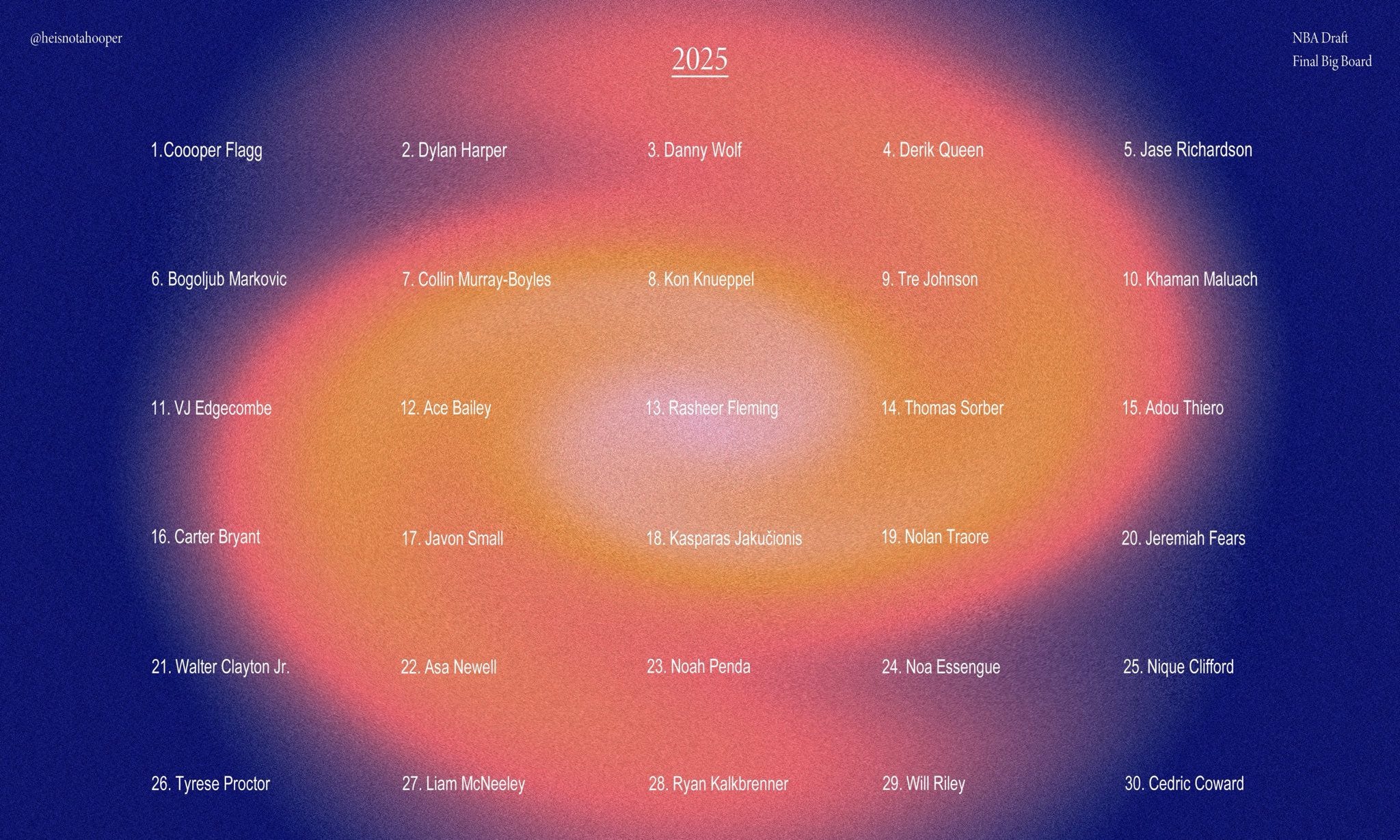
Identifying those with size and tangible creation ability was the core objective throughout the 2025 cycle. This process began with identifying those with positionally advantageous size/height, followed by those with primary-tier usage/efficiency, and finally distinguishing those with the lowest assisted field-goal percentage, emphasizing self-creation ability. Knueppel’s final projection was a miscalculation and overleverage in the favor of collegiate primary initiators, undervaluing his holistic contributions to an offense. The fluidity and fluency in which Knueppel oscillates off-ball to on-ball and so forth, exhibited in his scoring aptitude, playmaking, and rebounding—in totality exceeds the contributions of the on-ball contingent shot creating prospects of his class.
Knueppel, designated guard at Duke, was consequently evaluated based upon a key guard requisite: A hyperfocus in off-the-dribble three-point shooting talent. In conjunction with his 14.3% 3pt off-the-dribble (otd) shooting efficiency, 13.3% 3pt shooting efficiency in the PnR, and a less than ideal athletic profile, the prospect of Knueppel returning T3 value cratered. The final evaluation hedged against his shooting prospect. The unsure designation of Knueppel’s position was a consequence of not incorporating Bart’s role-classification feature into analysis, thus misconceptualizing Knueppel’s profile entirely.