Annotations: Keaton Wagler v. UCLA

Illinois (24) v. UCLA
Saturday February 21st
(L)94 - 95 (OT)
19 points | 8 rebounds | 6 assists | 2 turnovers
44.4% 2pt (4-9) | 16.7% 3pt (1-6) | 100 FT% (8-8)
51% TS | .533 FTr | 0.400 3PAr
1 steal | 2 blocks
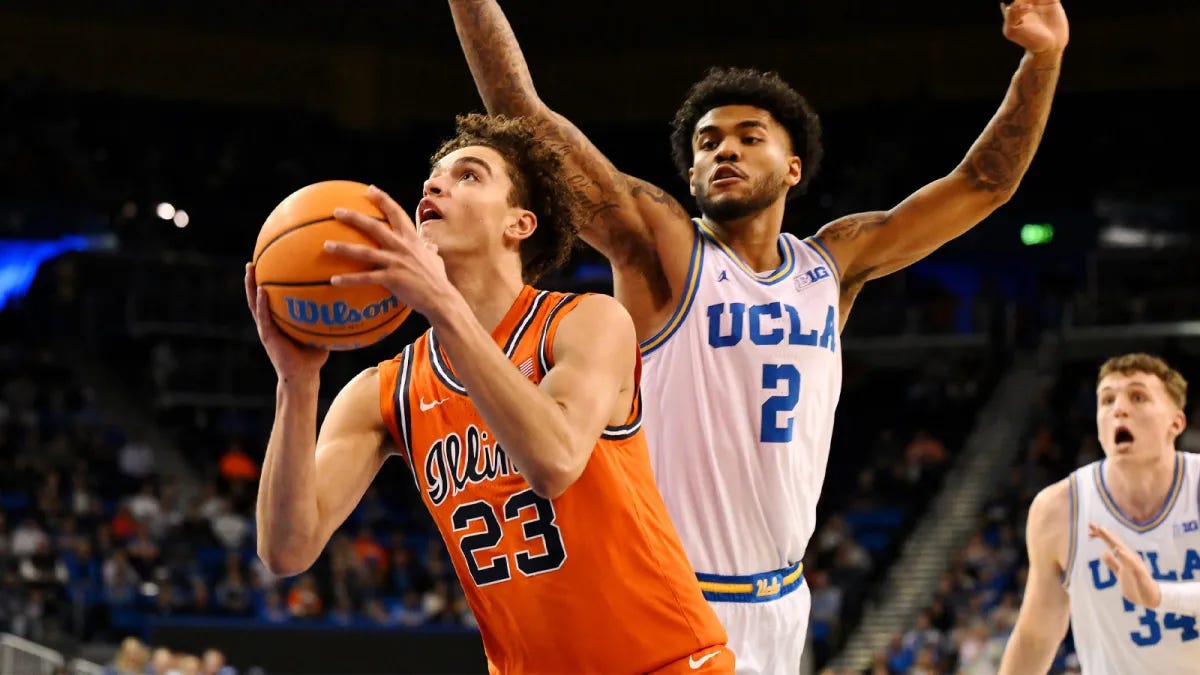
Concurrent with the rise in his draft rises a wave of doubters in Keaton Wagler’s ability to translate his strong freshman season at Illinois to the NBA. His performance against UCLA offers corroboration to both sides of the debate—Wagler maintaining his great influence on Illinois’ offense amid a poor shooting night, whilst demonstrating the consequences of a grievously limited athletic profile that’s limitations inevitably exacerbate at the NBA level.
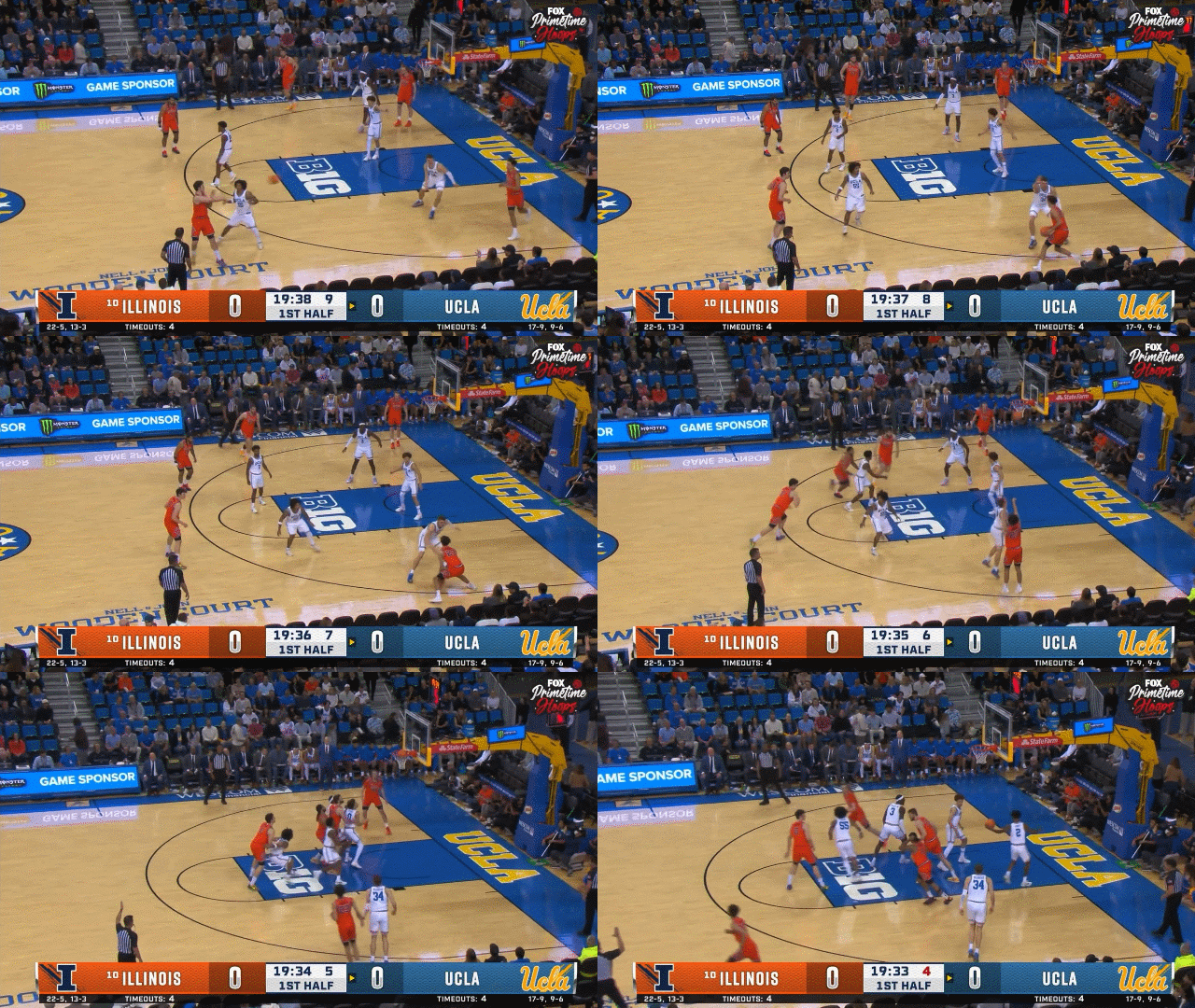
Versus UCLA, Wagler was without his greatest asset, his three-point shot, shooting only one-of-six from beyond the stripe. His sole three, his very first attempt of the game and Illinois’ first point of the night—initiated with a strong right jab off-the-catch, into a right-left cross pull-up jumper. A simple, basic shot sequence, exemplifying the comfort and fluency of Wagler’s shot preparation and subsequent mechanics: an efficient, swift, one-dribble maneuver to generate a window of space against a hounding UCLA close-out. Wagler’s succeeding threes, one catch-and-shoot, the remaining four off-the-dribble through pick-and-roll (PnR)/isolation possessions, were misses that could be chalked to misfortune rather than a “bad shot”, “rushed shot”, or a product of missed reads, negligence to the team. The catch-and-shoot, wide open, Wagler missed front rim. The pick-and-roll possessions, similarly dribble-efficient sequences to his made spot-up three at the start of this game, slowly approaching the high PnR before skipping (literally) into a change a pace (a clever feint Wagler utilizes to show “downhill” before changing direction east-west, or west-east, with a hard one-dribble tween, cross, or behind-the-back, immediately into a pull-up, spacing successfully generated). These aren’t poor quality shots. They require minimal shot-clock burn for Wagler to execute, and as a 41.4% 3pt shooter off-the-dribble, and better PnR shooter at 45.0% 3pt for the season (twenty-eight games and counting), these shots are encouraged, as one of Illinois’ (ranked number-one in adjusted offensive efficiency in the country per Barttorvik) strongest models of offense. Noted is the distance of each of these missed threes, or rather, Wagler’s shot profile from three overall, consistently firing off shots comfortably a ways back from the collegiate three-point line, an additive to his three-point ability. Unnerved by shooting distance, Wagler obliges defenders to wander out several feet beyond the three-point line, stressing the tether to their help-defense.
Juxtaposed by the “outlier”, “off-night” of Wagler’s poor three-point showing versus UCLA, is the consistency of an ordeal: Wagler’s two-point efficiency, or lack thereof. Measured unofficially at 6’6 with shoes, Wagler is shooting 49.1% 2pt, marking below-average and the lowest two-point efficiency amongst prominent freshman guard counterparts (Acuff, Peterson, Flemings, Brown Jr.,). Wagler isn’t fully distinct in this matter: Mikel Brown Jr. just crosses the 50% 2pt threshold, at 50.5%, Flemings in at 51.5%. In fact, per Barttorvik, Flemings and Wagler have identical splits at-the-rim, ~60%. The concern with Wagler nonetheless persists. Historically, 6’6-approximate prospects who shoot below 50% from two-point range, specifically those without the substantial shot diet of middys, offer negligible contributions in the league offensively, if not a net-negative return year-over-year (Kelly Oubre, Quentin Grimes, Lonnie Walker IV for instance). Wagler is indeed a poor midrange, non-rim two-point scorer, converting just 32.3% per Bart. Though in the case of Wagler, these non-rim twos should not drag his two-point efficiency in the manner it currently is, given its moderate volume. This suggests Wagler has an ordeal of a rim volume deficit. And parsing through his play types, it is specifically an issue of self-generating transition offense. Through 28 games, Wagler has just 25 possessions in transition, averaging 0.9 per game. In contrast, Flemings totals to 65. Acuff, 115. Peterson, in 17 games, 40 possessions. Mikel Brown Jr., 66 possessions in 20 games. UCLA marked Wagler’s fourth-straight game without a possession in transition, translating to zero opportunities for Wagler to cash in points in the open floor. Where his counterparts have bolstered their two-point efficiency in the open-court, Wagler has entrenched himself in the halfcourt, reliant on dribble-penetration and conniving finishing angles to manufacture shots at-the-rim. Conniving, however difficult. Wagler’s first recorded rim-attempt versus UCLA, an iso at the left wing, Wagler initially blowing by his defender with a swift right-left tween into an off-hand drive, forced to pick up his dribble just outside the hash marks as the low-man rotates up to steal the ball unsuccessfully, and, with Wagler in no-man’s-land, he opts for a step-through inside-hand lay off the glass, which rims out. A clean, creative sequence given the spacing and shot clock against his favor. Yet it is the manner of his finish that concerns. Wagler scarcely generates lift following his step-through, his finishing arm arguably the sole extremity activated in the layup attempt, solely dependent on the finesse of his touch to finish, rather than his entire body, his athleticism. Wagler’s second miss of the night, another iso possession, another possession in which he wins his defender from parallel to his body to his side (perpendicular to his shoulder). Still, as he picks up his dribble at the free-throw line, Wagler is easily pressed off his line by the sideways defender, Tyler Bilodeau, and with a massive gathering step attempting to regain balance, tries his left-side inside finish again, his right arm once more the sole extremity activated on the finish, and is promptly blocked off the low end of the glass by Tyler Bilodeau. His third miss is all but similar, once more blocked at the rim, his feet scarcely leaving the ground for the finish. Wagler’s on-ball makes (PnR or iso possessions) are consistent with his misses, against UCLA leveraging the basket as a safeguard against his POA with an opposite-side finish, still, his finishing arm doing most of the work in the execution. How this low margin for error, finesse-dependent finishing technique translates to the NBA is very uncertain. Exacerbated by the absence of transition offense, the margins increasingly narrow. A high free-throw rate for the season maintained versus UCLA, though, it’s uncertain this rate of foul-drawing can be sustained in the NBA. The fouls Wagler generated this game were a byproduct of him meeting illegal contact in the paint, not artistically drawing the foul through power akin to Dybantsa, or Mikel Brown Jr., in which it would appear to a referee that the defender committed a shooting foul as an inevitability to prevent the basket. Power in the NBA is derived by strength, speed, and/or a combination of both athletic traits. Neither of which Wagler possesses. Historically, high free-throw rate 6’6 approximate prospects with exceptionally low dunk attempts are for one, rare, and secondly, fail to translate their free-throw rate success from NCAA to NBA.
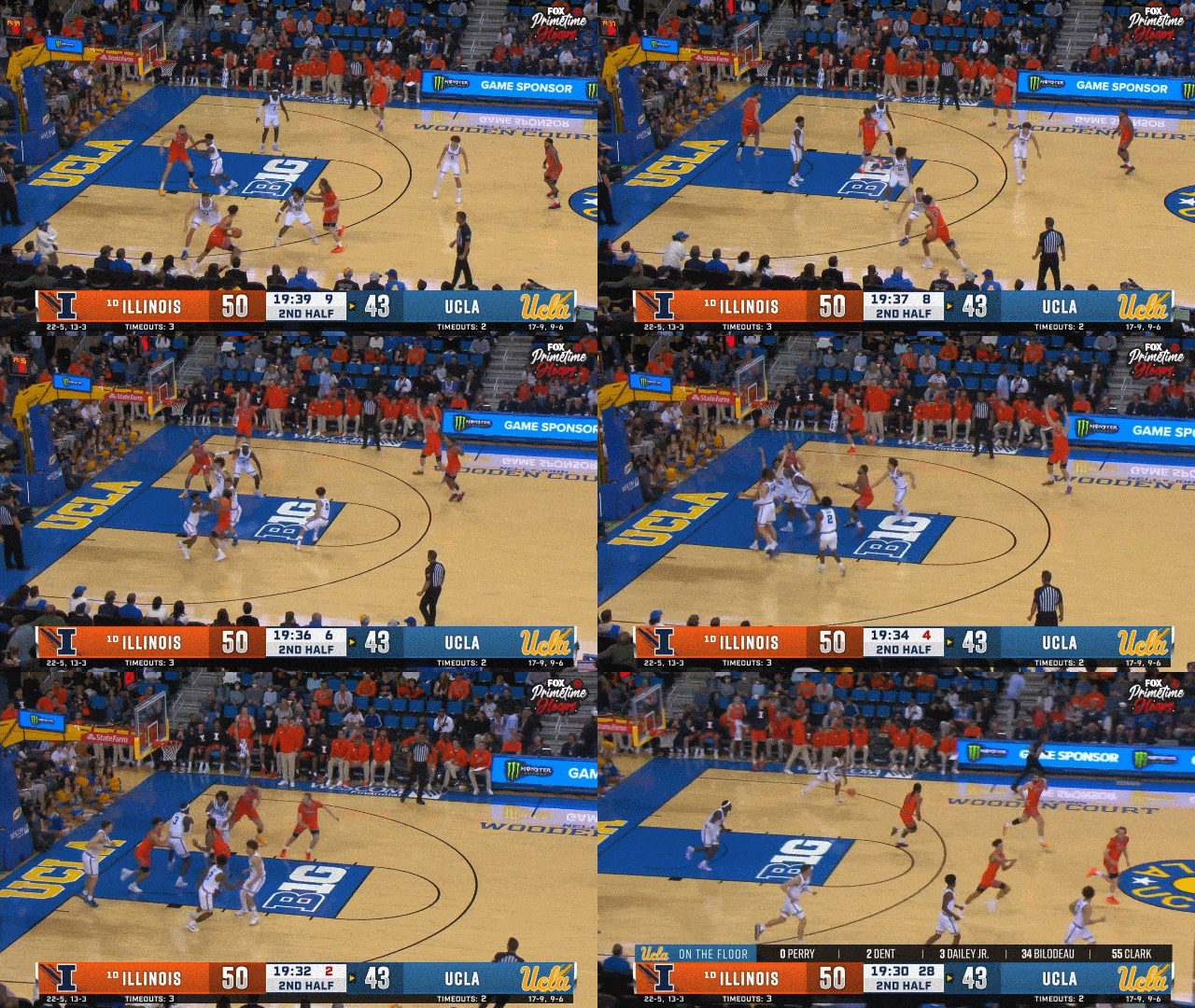
Wagler’s six assists versus UCLA asserts his function as a facilitator, Illinois’ offense established predominantly through ball-screens, Wagler as chief conductor. By Head Coach Brad Underwood and Offensive Coordinator Tyler Underwood’s design, these ball-screens, no matter the iteration (High PnR, Spain, Horns, etc.) are accompanied by a backline motion of some sort: backdoor cuts, flex actions, baseline cuts, the roller of a side PnR clearing to the opposite corner into a corner pin. This weakens the defense’s ability to tag or fortify rim protection, while enabling offensively continuous rim-pressure with cutting above-the-rim play-finishers or using the roller. Wagler is typically armed with both cutter and roller simultaneously. What intrigues with Wagler’s playmaking versus UCLA is his tenacity for producing dribble penetration, which draws in the low-man—the trigger for big Zvonimir Ivisic to cut to the rim unguarded for the lob dunk. It is once more Keaton Wagler utilizing dribble-efficient sequences to generate positional advantages against his POA, driving hard downhill with the defender at his side, that inevitably draws in the low man, in most possessions the defense’s sole rim protector. Wagler extends this production of dribble penetration beyond ball-screens possessions, generating multiple paint touches in isolation versus UCLA, drawing in the help and subsequently kicking out to his corner shooters, to which his teammates were unable to cash in.