
Annotations - Patrick Ngongba v. Virginia

Duke (1) v. Virginia (11)
Saturday February 28th
(W)77 - 51
11 points | 5 rebounds | 1 assists | 1 turnover
57.1% 2pt (4-7) | 50% 3pt (1-2) | FT% (0-0)
61% TS | 0.00 FTr | 0.222 3PAr
0 steals | 0 blocks
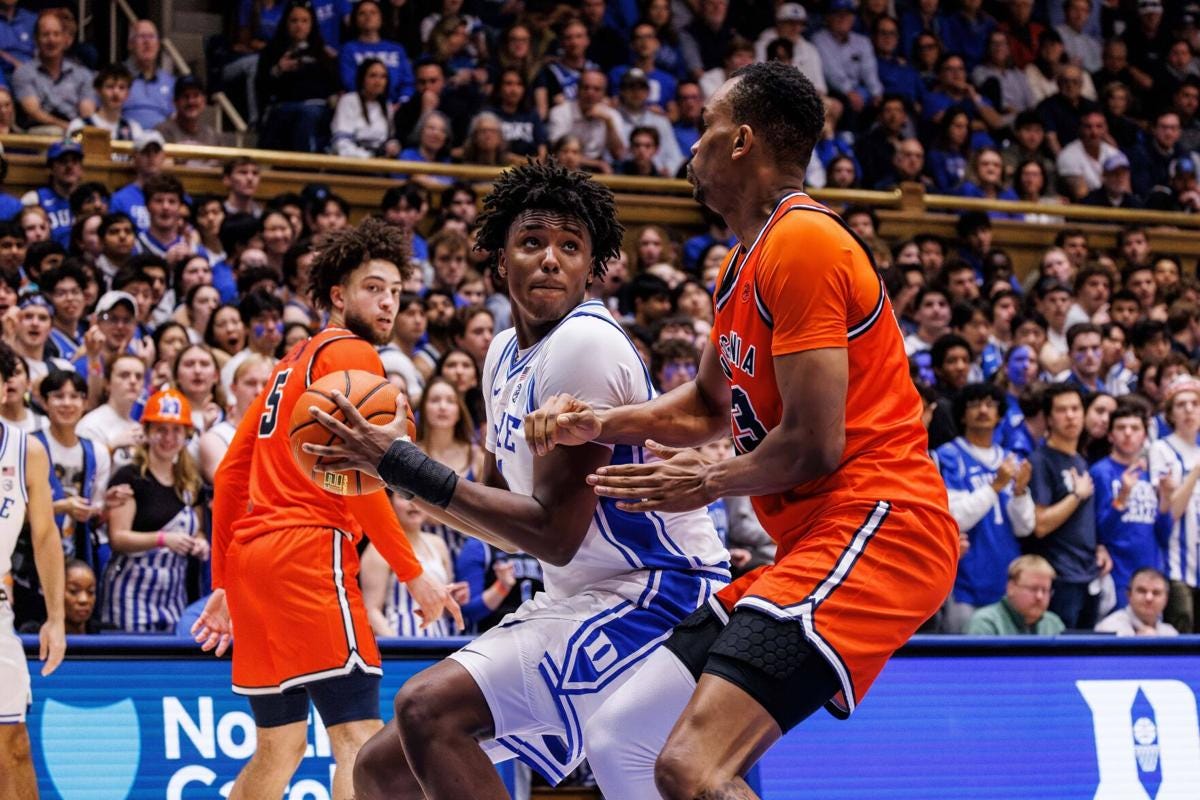
A subtle, modest prospect in contrast to the several others of this class who’ve set program scoring records, assist records, three-point records, Ngongba manages to shine in the in-between, the connective activities that coalesce an intricate machine. It is akin to power steering in a vehicle: a technology that allows for simple, effortless steering on behalf of the driver, its effectiveness unmistakable especially in heavy, large vehicles like SUVs. It is not a precondition to building a functional car. It is not the driver, the engine, nor the exhaust. However, the ease of driving achieved with power steering has metamorphosed the technology to becoming integral to every car on the market today. Ngongba isn’t a precondition to building the best team in the nation. He isn’t a do-it-all blue-chip freshman prodigy like Cameron Boozer, nor is he a two-way veteran upperclassman like Maliq Brown. Though, the ease and depth in which Duke can execute their offense, can fortify their defense with Ngongba integrated into their roster, has made him integral to the Blue Devils dominant success.
Duke’s blowout win versus the eleventh nationally ranked Virginia Cavaliers embodies this spectacle of dominant success, Virginia, 26-3 and 14-2 in conference play. This was Virginia’s first game of the season held under 70 points in a loss, their third game this season scoring under 70 points. The Blue Devils execute impeccable defensive schemes collectively, with defensive specialists Dame Sarr, Maliq Brown at the wing, Patrick Ngongba at center, flanked by Cameron Boozer and Caleb Foster. Ngongba, as Duke’s sole big—no other active player on the roster measuring 6’10 or taller—is invariably engaged with switching, tagging, rotating, containing, and rim-protection. With vast responsibilities, ever-changing within a single possession, it’s Ngongba’s perpetual activity that produces stops, enables teammates off-ball to dig for steals, and generates open-floor possessions. This “activity” isn’t recorded on the box score, rather, it is reflected in Duke’s defensive adjusted-efficiency, ranked number-one in the nation per Bart Torvik. First defensive possession for Duke, Virginia fast in transition capitalizing on a Dame Sarr turnover, Virginia guard Malik Thomas middle lane fervently looking for an open shooter against the unset scrambling Duke defense. Thomas shovels the ball to the trailing Johann Grünloh, who Boozer successfully deters from shooting, Thomas subsequently flaring out to the wing as Duke’s defense still scrambled. Ngongba immediately spots Thomas’ activity, rushing out the paint to contain the 6’4 guard at the three-point line, by which Thomas responds with a hard drive to the rim. Ngongba gets beat on the drive, Isaiah Evans is forced to rotate weakside corner to defend the rim, and as Thomas appropriately responds to this rotation with a weakside kickout to the wide-open Thijs De Ridder at wing, Ngongba reappears in the possession, jutting out from the opposite nail to contest the three, pressuring Thijs De Ridder into a miss. It’s not a perfect possession from Ngongba, he’s beat on the initial closeout, but it’s his initiative, an inner fuel that pushes him to show up twice to consequentially hinder Virginia’s shooters. The possession continued, Virginia nabbing the offensive rebound, Duke’s defense now set, and Ngongba subsequently drawn into a pick-and-roll. Ngongba, as the screen-defender, covers at-the-level, successfully driving the ball-handler wide from the right wing to the corner, cooly sliding his feet to match the pace of the ball-handler. Once the point-of-attack (POA) Caleb Foster recovered to the ball-handler, Ngongba seamlessly rotated back to the screener-big in the low post and immediately worked to deny any potential entry pass with a physical box-out. Virginia, with their initial pick-and-roll killed, Malik Thomas triggers another pick-and-roll top of the key, Ngongba again covering. But with only six seconds left on the clock, Thomas throws up a long-two, misses, Sarr recovers the ball, and Virginia’s extended possession ends fruitless. Near perfect team execution from Duke, the surety of shutting down Virginia derived directly from Ngongba. This application of defensive intuition flows all through the succeeding possessions from Ngongba. Consistent, sharp switches and rotations, denying actions by an incessant presence.
Ngongba’s defensive utility wanes on the perimeter, its weakest in possessions to which he’s switched onto a guard. Both premier guards for Virginia Malik Thomas and Chance Mallory found success generating clean blow-bys against Ngongba, Ngongba unable to contain the two from turning the corner, their downhill speed too fast, their frame/size too pliant for him to contain laterally. Ngongba bodes better against wing-size or greater ball-handlers, utilizing his shoulders and upper body to inhibit their drives. Ngongba’s shoulder activity jams a 6’8 wing’s movement, for instance, whereas a 6’4 guard can avoid the jam entirely. A rarity it is for centers, including the all-time defensive prospects—Evan Mobley, Chet Holmgren, Donovan Clingan, Victor Wembanyama—to effectively defend on the perimeter by themselves. While they can demonstrate utility in spurts, Wemby and Chet the best of this group due to their recovery talent (tall plus long wingspan plus near instant court mapping/processing equals chase-down blocks), these perennial defensive-player-of-the-year bigs are often situated at the dunker spot to offer weakside rim-protection/deterrence. For Ngongba, this means poor perimeter containment isn’t indicative of his defensive projections in the NBA, his interior deterrence, switch-activity more essential to contemporary defensive schemes. Ngongba shut down Virginia’s post-bigs and pick-and-roll ball-handlers, stifling dribble-penetration around screens, his physicality and Duke’s synchronous help-defense hindering paint touches. Ngongba, defending at-the-level to the screen, committed to containing the ball-handler, struggled switching back to the slipping screener once his POA recovered, to then contest at-the-rim. It’s a faculty of Wembey, Chet, etc. that differentiates them as top-percentile defenders. Ngongba’s moderate block-rate quantifies this weakness, the shortage of defensive playmaking, zero blocks or steals against Virginia, grows to an acute vulnerability of Ngongba in all of his efficacy as a ground-level defender.
Ngongba’s rebounding-rate and box-score numbers underrate his rebounding talent: an astutely active, physical rebounder, confident and assertive in the timing, execution of his jumps, shows great extension of length when reaching out to the ball, and authoritarian in possession. Ngongba proved his ability to win contested, physical rebounds, every board versus Virginia, a battle of positioning, of energy, attrition. In his first defensive rebound of the game, just midway through the first half, Malik Thomas fires off a quick three from a hand-off at the left-wing, Patrick Ngongba the sole player in the paint. Rather than absent-mindedly spectating the outcome of Thomas’ three-ball, Ngongba turns away from the basket, pinpointing the lurking Virginia big, Johann Grünloh, who would also be crashing the paint for the potential rebound. Locating Grünloh, Ngongba immediately gets to pressuring him out the paint, and even with the missed three by Thomas bouncing out in the favor to Grünloh, it’s descent directed to his outstretched palm, Ngongba stays in the mix, Grünloh off-balance in a clash of strength against Ngongba, Ngongba with the forward momentum, jumps and intercepts the ball, denying Virginia an extra possession.
With eleven points, Ngongba finished third in scoring for the Blue Devils, behind leading scorer Isaiah Evans and close second Cameron Boozer. Akin to their season averages, Boozer leads the team in possessions, Evans three-point attempts, and Ngongba rewarded as the sole cutting/rolling/dunker big on the roster. Ngongba primarily occupied either dunker spot or top of the key, functioning as a roller in pick-and-roll action or handoffs up top, and as a vertical spacer/lob threat down low. Versus Virginia, these designations enable Ngongba as a release valve, a bail out option of sorts for ball-handlers faced against shrinking defensive coverages. Rather than slow halfcourt pace with Ngongba setting a multitude of screens for Caleb Foster, Cayden Boozer, and Isaiah Evans, all three second-rate off-the-dribble scorers, a high pick-and-roll demanding articulate ball-control and shot-making ability, the three guards enter screening action with Ngongba mainly through handoffs. It allows Foster and Boozer to take the ball and turn downhill without disrupting momentum nor burdened with generating the momentum on-ball, facing the defense. Simultaneously, Ngongba, director of the handoff, orchestrates the angles and timing of the action, thereupon slipping to the basket, available behind the defense at the dunker spot, awaiting the lob. The advantage of these handoffs lie in Ngongba’s discernment. It is left to the sophomore when and how the handoff is disseminated, which therein simplifies the function of Duke’s guards. It is a degree of live-dribble, read-and-react competence by Ngongba, within an action or away, that elevates a halfcourt offense, despite not being a “spacer”.